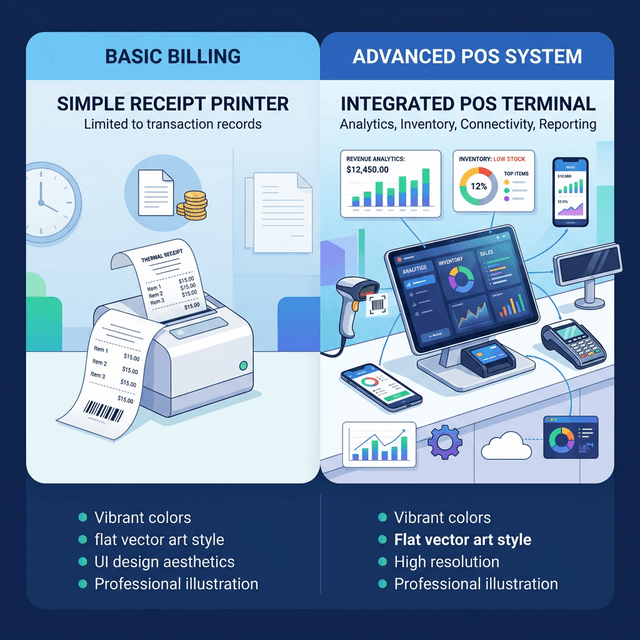
Restaurants often use the terms POS system and billing software interchangeably. While both systems handle customer transactions, they serve different operational roles inside a restaurant. Read our complete Restaurant Billing Software Guide for an in-depth understanding.
Understanding the difference between restaurant POS systems and billing software helps restaurant owners choose the right technology for their business operations.
This guide explains how POS systems and billing software differ, what features they provide, and how modern restaurants combine both systems.
What Is Restaurant Billing Software?
Restaurant billing software is a system used to generate invoices, calculate taxes, manage orders, and process payments.
Billing systems focus on the financial side of restaurant transactions.
Typical functions include:
- generating customer bills
- calculating taxes and service charges
- processing payments
- recording daily sales
- producing transaction reports
Billing software ensures that every order is accurately converted into a final invoice.
Modern restaurant billing software often integrates with payment gateways, accounting systems, and order management tools.
For a detailed explanation, see the restaurant billing software guide.
What Is a Restaurant POS System?
A restaurant POS system (Point of Sale system) is a broader operational platform that manages multiple aspects of restaurant operations.
A POS system includes billing functionality but also supports additional features such as:
- order management
- table management
- inventory tracking
- staff management
- reporting and analytics
POS systems act as the central control system of restaurant operations, connecting front-of-house staff with kitchen operations and management reporting.
Because POS systems include billing features, many restaurants refer to their POS platform simply as their billing system.
Key Differences Between POS and Billing Software
Although the two systems overlap in functionality, they differ in scope and operational focus.
| Feature | Billing Software | POS System |
|---|---|---|
| Primary purpose | Invoice generation | Complete transaction management |
| Order management | Limited | Full order tracking |
| Inventory management | Usually unavailable | Built-in inventory tracking |
| Table management | Rare | Common feature |
| Reporting | Basic financial reports | Advanced analytics |
| Operational scope | Billing focused | Full restaurant operations |
Billing software handles transactions, while POS systems manage the entire restaurant workflow.
When Restaurants Use Only Billing Software
Small restaurants sometimes use standalone billing systems instead of full POS platforms.
This typically happens in businesses such as:
- small cafes
- takeaway counters
- street food outlets
- food kiosks
In these cases, the operational complexity is low, and the restaurant primarily needs a system to generate bills and record payments.
When Restaurants Use POS Systems
Restaurants with more complex operations typically rely on POS systems.
Examples include:
- table-service restaurants
- multi-location restaurant chains
- restaurants with inventory tracking
- restaurants using kitchen display systems
POS systems help coordinate staff activities, track orders, and monitor business performance.
Benefits of Using POS Instead of Billing Software
Restaurants using POS systems instead of standalone billing software gain access to a broader operational platform.
POS systems connect order entry, billing, inventory tracking, and reporting within a single system. This connected approach provides several immediate advantages:
- Better Inventory Management: POS systems track ingredient usage in real-time, helping chefs manage stock levels and reduce food waste.
- Comprehensive Reporting: Beyond just revenue, POS systems provide insights into best-selling items, peak operational hours, and staff performance.
- Improved Table Management: Front-of-house staff can monitor table turnover and payment statuses, leading to faster service.
- Scalability: As a restaurant grows and adds locations, a POS system can unify operations across multiple sites, whereas simple billing software cannot.
In summary, this allows restaurants to monitor performance, track stock usage, and improve operational efficiency. Billing software focuses mainly on financial transactions, while POS systems manage both transactions and operational workflows.
Why Modern Restaurants Combine POS and Billing
In modern restaurant technology, the difference between POS systems and billing software is increasingly minimal.
Most modern platforms combine both functions.
These systems allow restaurants to manage:
- order taking
- billing
- payment processing
- inventory tracking
- analytics
within a single platform.
This integrated approach reduces operational complexity and ensures that all data flows through one system.
POS, Billing, and QR Ordering Systems
Modern restaurant technology also includes QR ordering systems for restaurants.
QR ordering allows customers to scan a QR code placed on their table and access a digital menu.
Orders placed through QR ordering systems are automatically sent to the billing or POS system.
This integration allows restaurants to:
- reduce order-taking workload
- improve order accuracy
- speed up table turnover
Many restaurants now combine POS systems, billing systems, and QR ordering platforms within a unified restaurant management system.
Choosing Between POS and Billing Software
When selecting restaurant technology, businesses should consider their operational requirements.
Important questions include:
- Does the restaurant require table management?
- Does the restaurant need inventory tracking?
- Are multiple locations involved?
- Is QR ordering required?
Small restaurants may operate effectively with simple billing, while larger restaurants benefit from a full restaurant ERP system or POS platform. Learn more in our complete Restaurant Billing Software Guide.
Ready to upgrade your billing system?
Switch to Epitto's cloud-based billing and ERP platform.
Start Your Free Trialarrow_forwardExample of an Integrated Restaurant System
Epitto is a cloud-based restaurant management platform that combines billing, POS, QR ordering, and ERP-level reporting.
Platforms like this integrate billing and operational management into a single system that allows restaurants to manage orders, payments, and analytics from one interface. Check our restaurant ERP system for more details.
Instead of using multiple disconnected tools, restaurants can operate using one integrated platform.
FAQ
Is restaurant POS the same as billing software?
Not exactly. Billing software focuses on generating invoices and processing payments, while POS systems manage broader restaurant operations including orders, inventory, and reporting.
Do small restaurants need a POS system?
Small restaurants may only require billing software if their operations are simple. However, POS systems provide additional operational insights that help restaurants grow.
Can POS systems generate bills?
Yes. Billing functionality is usually included within POS systems.
Can billing software integrate with QR ordering?
Many modern billing systems integrate with QR ordering platforms, allowing customers to place orders and pay directly from their phones.